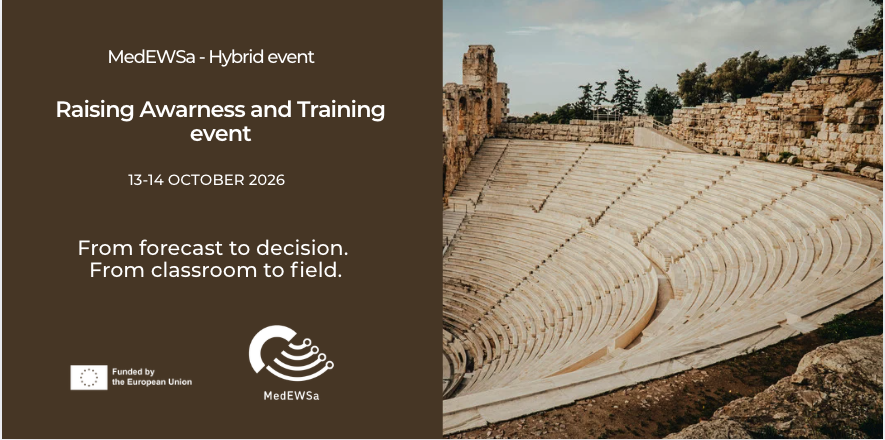
On 13 and 14 October 2026, MedEWSa will hold its Raising Awareness and Training Event in Athens, hosted by the Independent Directorate of Civil Protection of the Region of Attica, with the European Centre for Medium-Range Weather Forecasts (ECMWF). The event takes place in the final weeks of the project and has one aim: to put what MedEWSa has built into the hands of the people who will use it.
The first day, held in hybrid format at the Civil Protection Directorate in Marousi, is devoted to training and the operational use of project outputs. After opening remarks from the Region of Attica, ECMWF and the MedEWSa coordination team, ECMWF experts will guide participants along the full early warning chain. They begin with forecasting and uncertainty, move through hazard and impact indicators, exposure and vulnerability, and arrive at the thresholds and risk matrices that turn forecast information into decisions.
The afternoon focuses on the project’s tools and on the Attica pilot. Participants will be introduced to the MedEWSa Decision Support and Dissemination System (DSDS) and the four MedEWSa Twins. They will also learn how inclusive warning messages are designed and how the risk transfer and crisis management support tools work. These include the parametric insurance training tool, the solidarity fund and the rapid mapping request helper. The day closes with an end-to-end scenario exercise, in which participants follow a single event from forecast to hazard and impact interpretation, warning communication and operational preparedness decisions.
The second day moves from the classroom to the places where early warning matters most. Organised by the Region of Attica, a field trip will take participants to Mati, the wildfire-affected area, and to Mandra, which was hit by devastating floods. The visits will focus on disaster impacts, the challenges faced by civil protection operators, and the lessons learned on the ground.
Together, the two days reflect the approach MedEWSa has followed since 2023: impact-based, multi-hazard early warning built together with the users who rely on it. Seeing how a forecast becomes a warning, and then visiting the places where warnings have mattered, connects science to practice.
Participants can join in person in Athens or follow Day 1 online.